
Beer is a pretty big deal, and only a fool would fail to recognize this. In towns and cities all across America, robust local and regional brewing has created a tempest of breweries, brew pubs, bars, and restaurants, where the beer flows fast and is dizzying in its variety and complexity.
Ten years ago this wouldn’t just have been unusual; it would have been virtually magical. Sure, the neighborhood bar might carry something from Sierra Nevada or Magic Hat, or you might be able to find a Dogfish Head or an Ommegang if the manager at the local foodie restaurant knew what was what, but outside of a couple of craft IPAs (India Pale Ales) being on tap, it was unlikely that you’d be able to find anything particularly unusual in most dining establishments, and supermarkets held even fewer surprises.
These days, in an era where just ordering a cup of coffee can seem like a trial, five minutes in a supermarket with a good craft beer selection can be challenging, and at the cool new restaurant that just opened down the block, trying to decode their 20+ craft beer list will make you feel like you need a degree from the Sorbonne. Because seriously, what on earth is a “Rauchbier,” how is it different from a “kriek lambic,” and can someone please tell me how to pronounce these things? The guys at the bar keep talking about “Brettanomyces,” which frankly sound terrifying, and what’s up with “bottom fermentation” versus “top fermentation”? Isn’t beer just yellow and fizzy?
Of course, some beer is indeed still yellow and fizzy, but unless you enjoy parading your ignorance, its best to keep questions like that to yourself. Where then do you go for information?
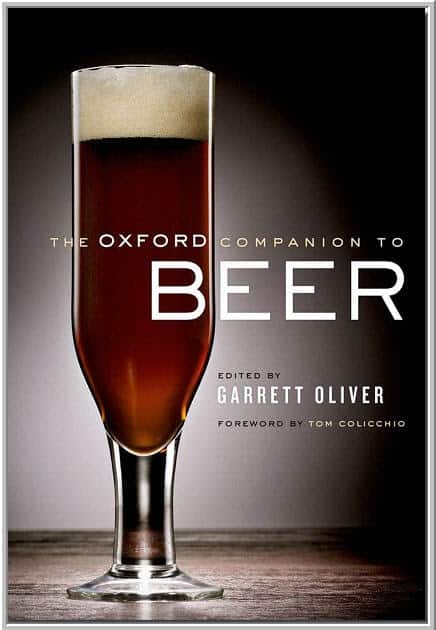
And for those who do already have some experience with beer, where do you go for even more education and guidance? The answer, for both neophytes and grizzled veterans, is the same: read The Oxford Companion to Beer. This book, edited by Garrett Oliver, Brewmaster at Brooklyn Brewery and recent recipient of a James Beard Award, may be the last beer book you’ll ever need to purchase. With over 900 pages of text, The Oxford Companion to Beer is no mere encyclopedia; the book is a veritable cornucopia of beer-related information, a horn-of-plenty of facts, dates, obscure definitions and references, pictures and descriptions, and assorted tidbits, all wrapped up as an attractive (and somewhat hefty) hardcover book that’s sure to see a lot of use.
Suddenly, the 20+ beer list doesn’t seem so intimidating. When someone strikes up a conversation you can talk about how top-fermenting yeasts produce ales, while bottom-fermenting yeasts produce lagers, and then slip in the fact that these terms are not actually absolute and that most yeasts ferment somewhere in between.
You can talk about how a Rauchbier is a German-style beer made with smoked malt and that it tastes like a campfire that made love to a keg full of lager (although maybe don’t say that to a stranger), and that a kriek lambic is a lambic (a type of sour wheat Flemish beer brewed in Brussels) which experiences a second fermentation over crushed or macerated sour cherries. Or, don’t say anything at all, privately secure in the fact that you know more about what you’re drinking than all the people around you who are ordering blindly from the enormous laminated, and weekly-changing, menu that they’re staring at, glassy-eyed and alone.
Disclaimer: The Cook’s Cook accepts sample products for review. We endorse products only after testing and approval by our staff.
The Cook’s Cook is a participant in the Amazon Services LLC Associations Program, an affiliate advertising program. We may receive a commission on items purchased through our links.
Grilled Guinness-Basted Chicken

Ingredients
- •One 1½ - 2 kg (3½ - 4 pound) chicken
- •One can or bottle of Guinness or other dark beer
- •59 ml (¼ cup) brown sugar or 2 tablespoons maple syrup, fruit jelly, or preserves
- •1 teaspoon salt
- •½ teaspoon freshly ground black pepper
- •Bacon fat rendered from frying 8 ounces of bacon, cooled, or 59 ml (¼ cup) olive oil or vegetable oil
- •2 bay leaves, optional


Preparation
Place the chicken on a work surface and use kitchen shears to cut along either side of the backbone and remove it. Turn the chicken over, spread the chicken open like a book, and press down firmly on the breastbone until it cracks and flattens.
Re-shape the chicken so it is compact, and place it in a large heavy-duty sealable plastic bag. In a mixing bowl, combine the beer, brown sugar, and salt and pepper. Whisk to blend. Add the bacon fat or oil, and whisk again until well-blended. Add the bay leaves, and pour the mixture into the bag. Carefully (so that the bones don’t puncture the bag) turn the bag so that the mix coats the chicken. Refrigerate, up to 24 hours, until ready to grill.
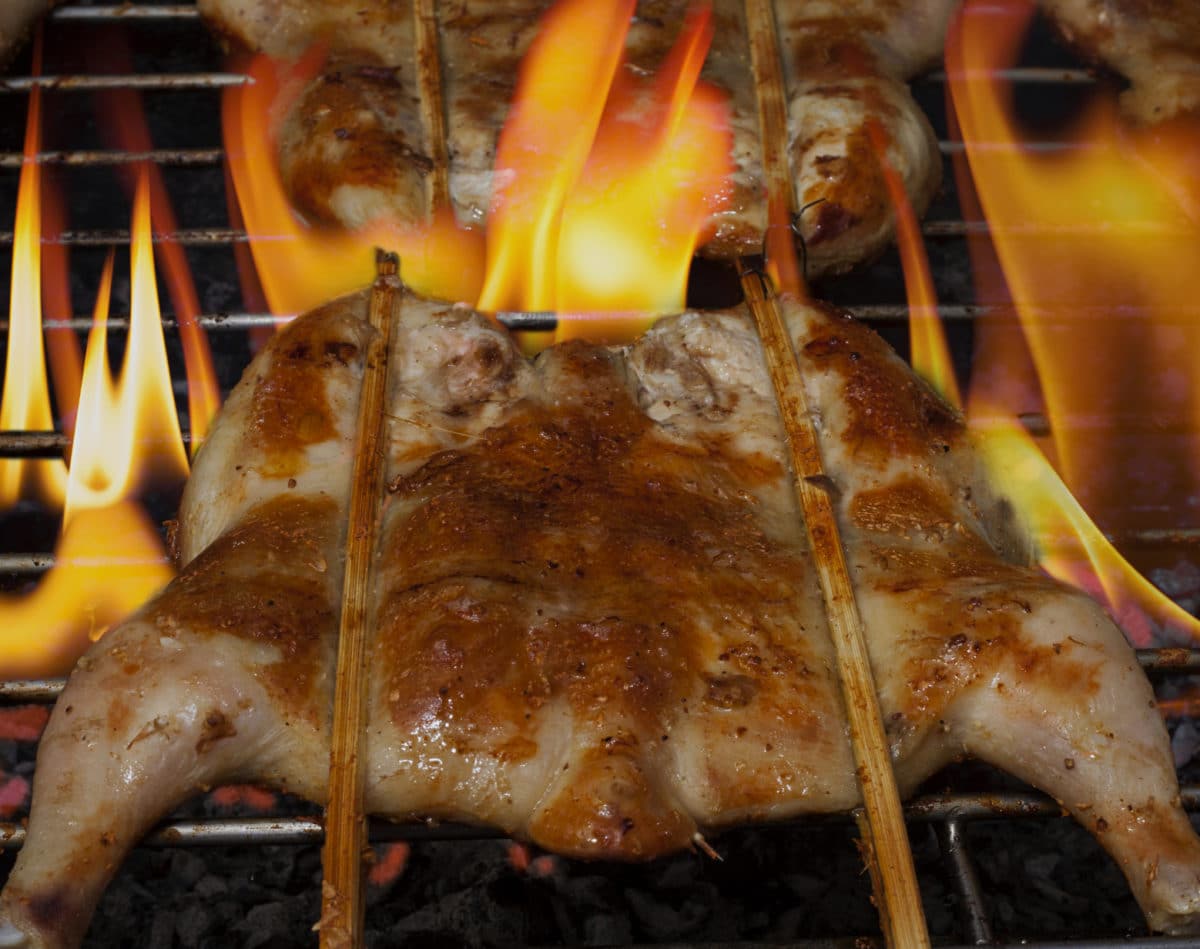
Transfer the chicken to a work surface, reserving the marinade. Flatten the chicken again, skin side up. If metal or bamboo skewers are available, thread two through the chicken to keep it intact during cooking.
Prepare a moderately hot wood or charcoal fire with a pan of cold water nearby in case of flare-ups from dripping fat. Place the chicken skin-side up on the grill, and cook until golden on the underside, about 15 minutes. Turn the chicken and continue to cook, basting with the reserved marinade, for another 15 minutes. Continue to cook in this fashion until juices run clear and an instant-read thermometer reads 82° C/180° F. when inserted into the thickest portion of the thigh, 45 minutes to one hour total cooking time. Cut the chicken as desired, and serve.