

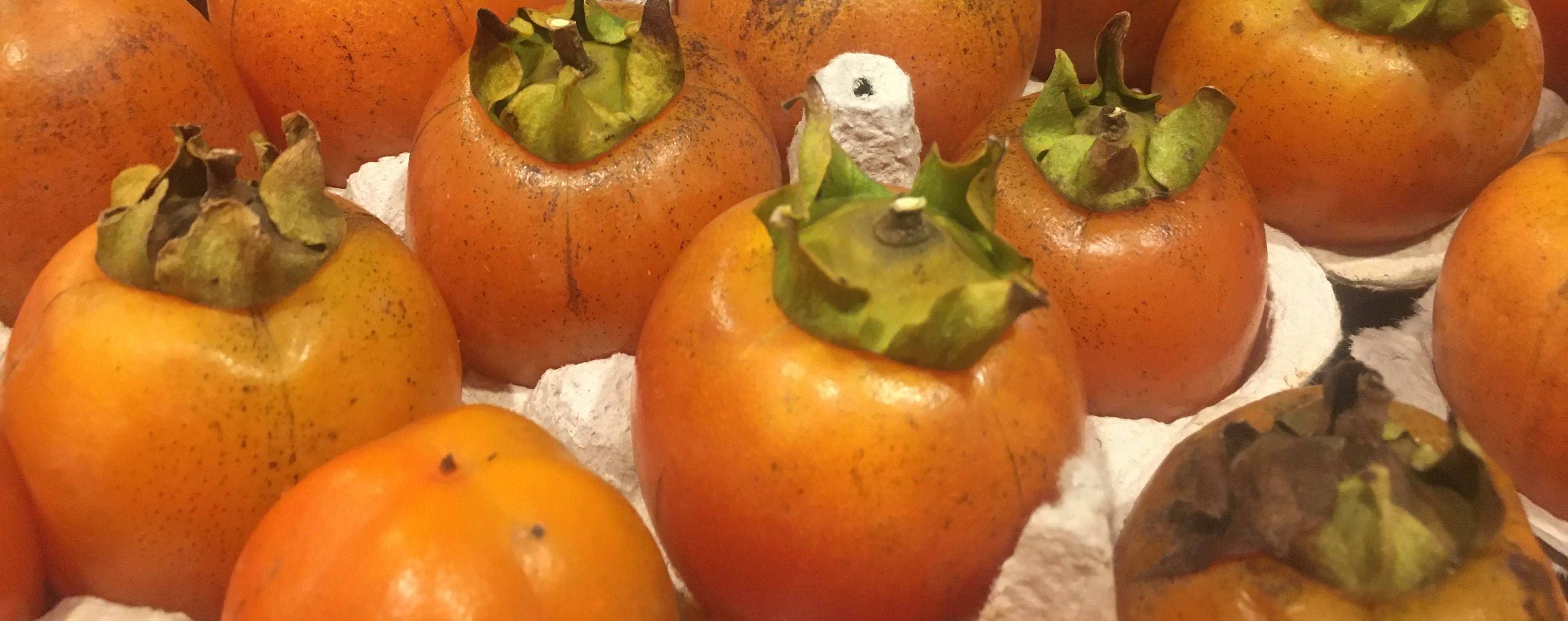
When the days get shorter and the nights grow cool, I dream about harvesting the world’s most magical fruit. It is like I am holding an incredible secret—something so wonderful, and I just want to scream it from the rooftops so everyone can share the experience. The broader harvest time coincides with persimmons, my favorite flavor of fall, a gorgeous orange fruit that is amazing when eaten fresh, grilled on an elegant kabob, or smashed into a bowl of yogurt and granola. Persimmons hold the title of King of Under-Represented Fruits, something as universally unknown as they are delicious. But why is this amazing fruit so foreign to our palate?

The main reason is that it is amazingly delicate. Fully ripe persimmons are extremely fragile, making them rare at standard supermarkets and even local farmers' markets. The other reason is that they are often misunderstood, as one bad experience with an unripe astringent persimmons can tarnish persimmons perception forever.
So let’s take a look at persimmons, and how they grace the harvest season with flavor, aroma, and a spectacular addition to the fall culinary pallet. Persimmons may be classified into three major groups. Non-astringent, astringent and hybrid.
Non-Astringent Persimmons
Non-astringent persimmons are shaped like flat-ish, squatty apples. These are usually eaten while firm, crisp, and uniformly orange. They can be enjoyed fresh out of hand or even grilled with vegetables and meats. They accept the flavor of a marinade extremely well. Non-astringent persimmons are amazingly sweet and flavorful, packaged with the smooth texture of a soft apple. Popular selections include 'Fuyu', 'Jiro Fuyu', 'Matsumoto', and dwarf choices like 'Izu' and 'Ichi Ki Kei Jiro'.
Astringent Persimmons
Astringent persimmons are a conundrum. They are the reason most people love persimmons or absolutely abhor them. The astringent persimmons ripens from green to intense orange-red, but if eaten before it is soft, it invokes face-puckering bitterness. Folks that don’t like persimmons usually had an experience with an incompletely ripened astringent persimmons, picked too soon and transported for sale. But when that fruit is allowed to progress to the feel of a fragile water balloon, it is celebrated by those with a sweet tooth, an explosion of fruit flavor and intense sweetness. The experience is best described as fruity honey, a delectable goo that is delicious on its own, but also brilliant over vanilla ice cream, in a bowl of yogurt, or mixed with granola. Common varieties include 'Saijo', 'Hachiya', 'Giombo', 'Ormond', 'Honan Red', and 'Rojo Brillante'.
Hybrid Persimmons
Hybrid persimmons came about by crossing North American and Asian species. Varieties include 'Nikita's Gift' from Ukraine, a smaller fruit with a spectacular flavor upon ripening. This variety grows on compact trees with striking fall foliage, producing 3-inch fruits that burst with sweet, fruity aroma.
Where Do I Find Them?
Despite the amazing flavors and aromas, persimmons do not ship well, and while some types of non-astringents find their way into grocery stores, the astringent, sweet varieties are too fragile, even for farmers markets. A few ambitious growers will take on that harvest, usually selling fruit in egg cartons, as they are even more fragile than eggs.
Adding persimmon trees to a home garden is straightforward, provided you match the variety to your space. Native North American trees produce small, astringent fruits on giant 30–60 foot tall trees, and require male and female trees to produce a crop. On the other hand, Asian and hybrid varieties tend to be much more compact, often maxing out between 10 and 30 feet, making them ideal for smaller yards. The Asian varieties are seedless and do not require a pollinator. Trees purchased at local nurseries are typically Asian persimmons grafted onto hardy North American rootstocks, making them amenable to diverse soils. Both North American and Asian persimmons survive cold well. However, Asian persimmons are sensitive to temperatures below 5°F, making the North American varieties a better choice for colder climates.
In short, if you can try a persimmon at your farmers market, do it. If you want to grow them at home, persimmons are low-maintenance, productive, and delicious additions to any backyard. Your primary challenges will be sharing the harvest with local wildlife, finding clever persimmons recipes, and rehoming excess fruit with happy neighbors. A persimmon tree is a delicious investment you will likely wish you had made years earlier, so take a taste of fall, and enjoy some persimmons.