

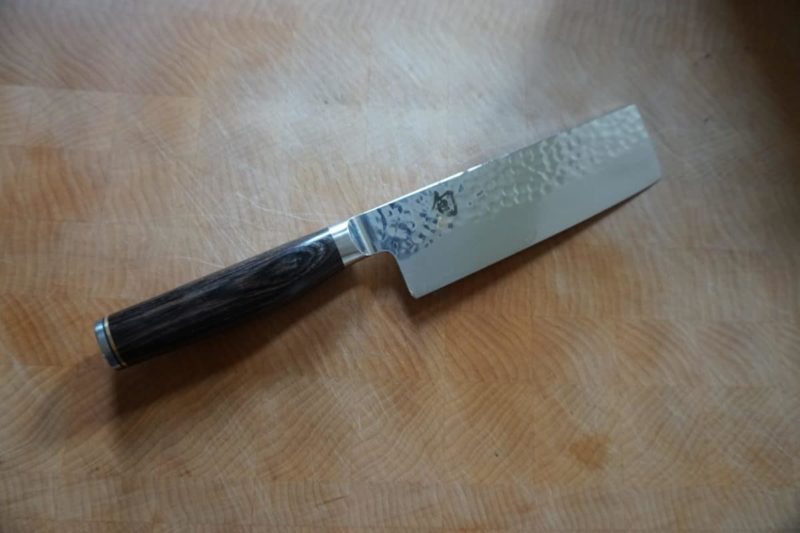
The Shun Premier Nakiri knife is the essential kitchen tool.
Clear a space in your knife block for the most beautiful knife you will ever own.
Why add a Shun Premier Nakiri knife your collection?
I’ve cleared a space in my knife block for Shun’s Premier Nakiri knife and have banished another formerly-essential knife to the dusty confines of a kitchen drawer. That that should indicate how taken I was with the Premier Nakiri, and how much I expect to use it in the future. While I spend an inordinate amount of time window shopping for kitchen knives, it’s hard to justify adding one to my collection. After all, most people can get away with owning just three blades: a chef’s knife, a pairing knife, and a bread knife, and good knives are a bit of an investment.
Shun Premier Nakiri Blade Design
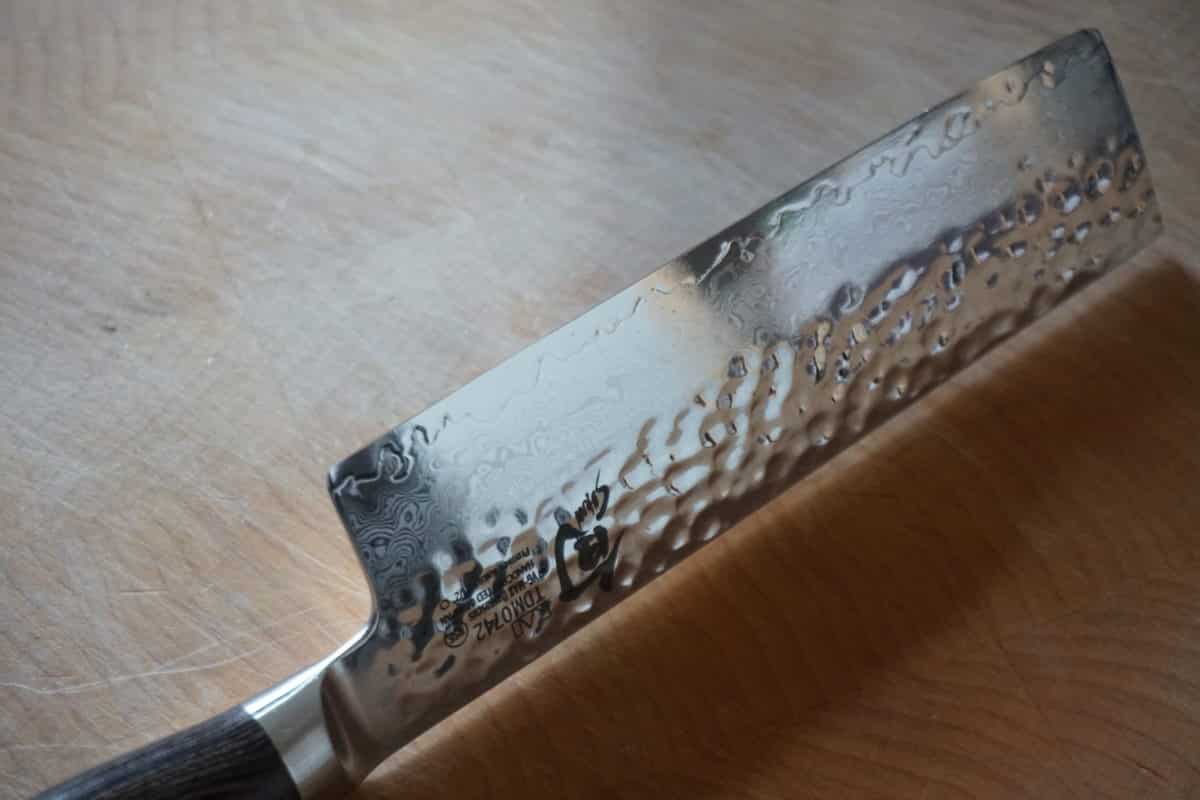
One of the first things you’ll notice about the Premier Nakiri is its gorgeous, somewhat unusual blade design, featuring a blunt tip which almost appears as if part of the knife was lopped off during the forging process. That design is integral to the purpose of the knife: nakiri knives (a style from Japan) are traditionally used to slice vegetables. The blade geometry—with its blunt tip and straight cutting edge—means that this style of knife relies on a “push” cutting motion, where you move the knife forward and down.
For vegetables, even cuts are vital. Even pieces cook, well, more evenly, and the visual appeal of beautiful even slices can’t be denied. And while nakiri knives are thought of as vegetable knives, they’re just as well suited for fruit, or charcuterie, or really anything where you want beautiful, even slices.
From a technical perspective
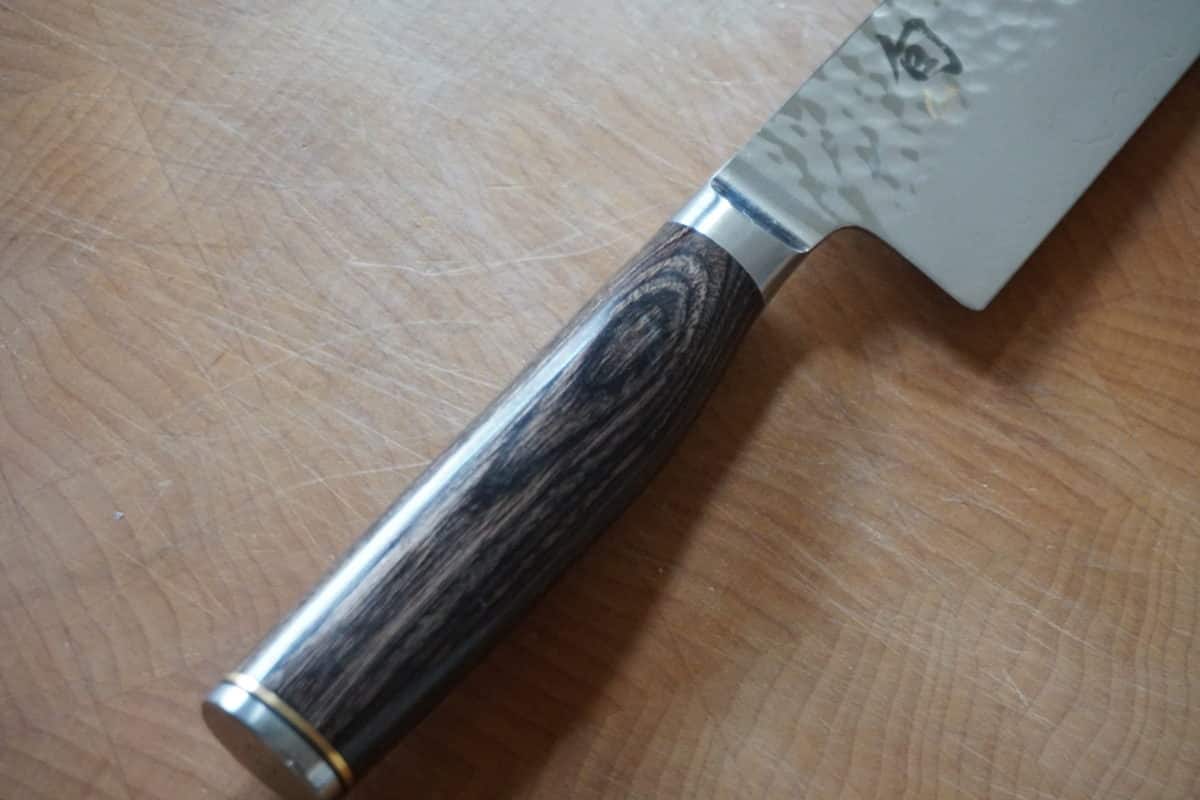
Everything about the Shun Premier Nakiri knife has been designed to make slicing easier. The tsuchime (hammered) finish helps food release from the blade, meaning that slices of food don’t get stuck on the metal while you’re slicing. The rounded handle made from moisture-resistant Pakkawood® (a type of hard, engineered wood) is comfortable, and the bolster (the part of the knife in between the end of the blade and the handle) is elongated, making it easier to use a pinch grip. The blade itself is also strong and thin, with damascus-style cladding running along the cutting edge. All of this translates into a knife that is stunningly beautiful and corrosion-resistant, and will maintain a sharp edge for longer.
From an aesthetic perspective
The Premier Nakiri is without a doubt the most beautiful knife in my kitchen. When I showed it to two friends who were in the process of building a wedding registry, they removed a knife block from their gift list and instead bought themselves the Premier Nakiri and two other knives from the same collection. And for those who lack confidence in the kitchen and don’t like the feel of a long, sharp knife in their hands, the shorter, blunt edge makes the Premier Nakiri lighter and easier to maneuver.
Vegetables can be tricky, and getting the most out of them means having knife skills that many people don’t possess. While the Shun Premier Nakiri knife won’t magically give you those skills, it will make creating nice, thin, even slices easier, which translates into both better looking final dishes and a better final consistency. It’s a worthy addition to your kitchen, and a knife that will last for decades if you take care of it correctly.
When I showed it to two friends who were in the process of building a wedding registry, they removed a knife block from their gift list and instead bought themselves the Premier Nakiri and two other knives from the same collection.
Apple Galette
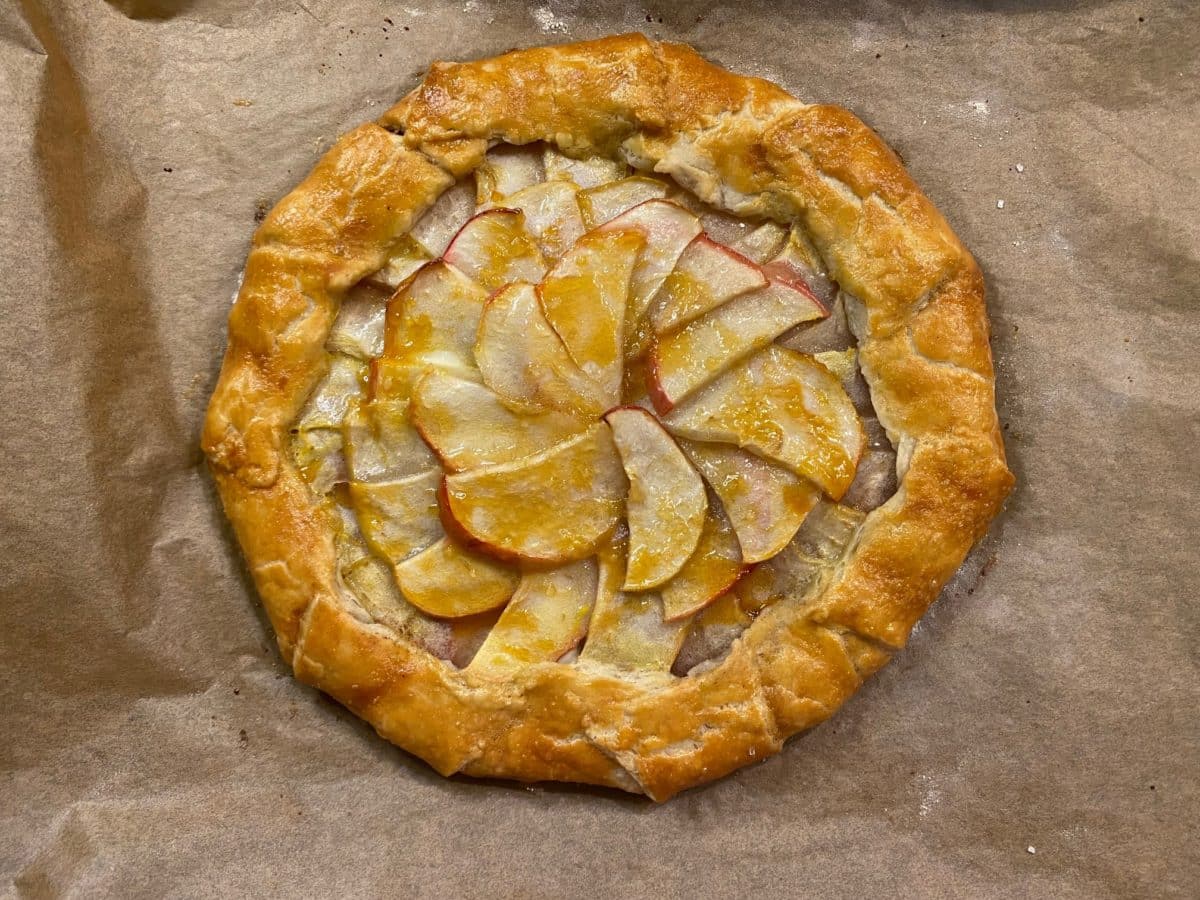
This Apple Galette recipe was my chance to develop a recipe that uses the best fruit this season has to offer and test out the Shun Premier Grey Nakiri knife.
With the ushering in of the fall and the burgeoning desire for warmth and comfort, so also comes apple season. In my household, that’s something of a big deal.
While I’m not typically a dessert person, I find it impossible to resist any kind of fruit-topped pastry. And I have a deep and abiding love of baked apples. Also, my wife who loves to bake, graciously indulges my constant inquiries of, “how about something with apples?”
Nakiri knives are traditionally used to prep vegetables. But their ability to evenly slice fruit is unmatched. And apples, with their crisp texture and sturdy structure, are the perfect vehicle to highlight what the Premier Nakiri is capable of achieving.
The key with this apple galette recipe is to slice the apples into thin, even slices. It is a feat the Nakiri makes delightfully easy. Having thin slices makes it easier to shingle them onto your galette. Tight, even shingling creates a galette with both a beautiful appearance and a nice texture. While the top of the apples takes on a slightly wrinkled appearance, their underside is soft and tender. This means that every bite has contrasting texture. This recipe recommends layering the apples in a design of your choice. However, I recommend arranging them into circles, starting with the outer edge first and working your way in. For maximum visual appeal, reverse the direction the circles go in—the alternating direction is more arresting to look at.
Even better, you don’t have to peel the apples before you begin slicing them. In fact, this recipe actually performs better if you don’t peel the apples, and the slender, crimson-bordered slices create a beautiful appearance when you shingle them. Lastly, sprinkling the sugar and salt mixture underneath the apples grants all the flavor you want, while keeping the surface unmottled and pristine. A light brush of butter and sprinkle of sugar add a golden sheen. The end result is an apple galette recipe that’s easy to make, takes full advantage of the Shun Premier Nakiri’s slicing ability, and is remarkably low in sugar.
Ingredients
For the dough:
- •113 grams (4 ounces) unsalted butter
- •132 grams (1 1/4 cups) all-purpose flour
- •7.5 ml (1/2 tablespoon) sugar
- •4 ml (3/4 teaspoon) salt
- •44-59 ml (3-4 tablespoons) ice cold water, or as needed
For the filling:
- •2 large Honeycrisp apples, washed, unpeeled
- •30 ml (2 tablespoons) freshly squeezed lemon juice
- •7.5 ml (1/2 tablespoon) sugar
- •7.5 ml (1/2 tablespoon) kosher salt
- •2.5 ml (1/2 teaspoon) ground cinnamon
- •.5 ml (1/8 teaspoon) freshly ground nutmeg
- •.5 ml (1/8 teaspoon) ground ginger
For assembling and baking:
- •1 large egg, beaten well
- •5 ml (1 tablespoon) butter, melted
- •5 ml (1 teaspoon) sugar


Preparation
- For the dough: Cut butter into 1.3 cm (1/2-inch) cubes and refrigerate it (or if it is soft, put it in the freezer). In a medium bowl, whisk together flour, sugar, and salt. Toss butter cubes with the flour mixture; using your hands, coat each cube with flour. Using a pastry cutter or a fork, cut the butter into the flour until the mixture is crumbly. Begin adding the ice water, a few tablespoons at a time, until the dough begins to stick together. It will feel thick and moist, but should not be wet. Form the dough into a ball, wrap tightly with plastic wrap, and refrigerate for at least three hours.
For the apple filing: Put the lemon juice in a large mixing bowl, and set aside. Stand each apple up on a cutting board so that the stem faces the ceiling. Using a Shun Premier Nakiri, beginning from the right side of the apple moving inward until you hit the core, slice into .3 cm (1/8th-inch) thick slices. Cut the slices in half, add to the bowl, and toss to coat with juice.
Rotate the apple 180° and perform the same slicing on the opposite side of the apple. Cut those slices in half and add to the bowl. Cut off the two remaining sections of apple, leaving a square-shaped core. Discard the core, take the two remaining sections of apple, and place them flat on a cutting board with the skin-side facing the ceiling. Slice into .3 cm (1/8th-inch) thick slices add to the bowl, and coat with evenly with lemon juice. In a small bowl, combine the sugar, salt, cinnamon, nutmeg, and ginger. Mix well, and set aside.
For assumbling and baking: Preheat the oven to 177°C (350°F). Line a rimmed baking sheet with parchment paper. Remove pie dough from refrigerator and rest on counter for ten minutes before rolling out. On a well-floured surface, roll out the dough until it is at least 13 inches in diameter. Trim the dough to form a 33 cm (13-inch) diameter circle and transfer to the parchment-covered baking sheet.
Sprinkle the spice mixture evenly across the dough. Using a fork, mark 4 cm (1.5 inches) into the pie dough to ensure sufficient pie dough is left on the edge to wrap over the apples. In a pattern of your choosing, overlap the thinly sliced apples on the pie dough. For best results, tightly overlap the apple slices (the thinness of the apples allows for you to easily design your own pattern). Cut slits into the sides of the pie dough every 8 cm (3 inches) to create flaps. First fold over every other flap, then fold up the remaining flaps. This ensures a nice round, galette with an attractive border. With moistened fingers, seal the outer edges where the flaps meet.
Using a pastry brush, paint the beaten egg over the folded-over pie dough. With a clean brush, paint the melted butter over the apples, and sprinkle with sugar. Bake until golden brown and fragrant, about 60 minutes. Allow to rest for at least 15 minutes before serving.
*A rimmed baking sheet for the galette will protect your oven in the likely event that the galette leaks juices during baking.