


Have you ever enjoyed a steaming bowl of Portuguese Caldo Verde (Green Broth Soup)? This soup, which originated from the Minho Province in Northern Portugal, is not only a sharp contrast to the majority of Portuguese soups known for their hearty meal-in-a-pot character but is such an iconic soup that it is often referred to as the national soup of Portugal. So simple and light in comparison to the others, I’m continually surprised to see misrepresentations of what it is and how it is made. For example, I have seen professional chefs and home cooks try to pass off as Caldo Verde soup plates piled high with mashed potatoes surrounded by a moat of broth. I had to laugh at the explanation from one chef, which was that he’d heard “the Portuguese like lots of mashed potatoes in their soup.” Another cook incorporated peas, ham and chunks of sweet potatoes and called it Caldo Verde. Please, do not call these creations Caldo Verde because they are not. Call them something else. As an Italian chef friend once exclaimed to me, “Tiramisu is tiramisu, but when people add blueberries and strawberries to it, now it is no longer tiramisu – call it something else.”
The Portuguese have numerous kale soups with various combinations of ingredients of legumes, root vegetables like carrots, and white and sweet potatoes, plus squash, sausages, and other leafy greens, herbs, and spices. Traditionally, what ingredients were on hand on a given day lent themselves to variations. However, Caldo Verde is Caldo Verde is Caldo Verde. This simple soup is being over-thought. The ingredients speak for themselves. The vibrant color of tender greens, considered reflective of the green Minho province countryside, gives a green hue to the broth. It is an economical dish and by simply omitting the sausage it is not only vegetarian-friendly but can be served as an understated elegant first course. It is a potato-based soup flavored with olive oil, some onion, a fine chiffonade of greens, seasoning, and a garnish of sautéed thin slices of Chouriço sausage.
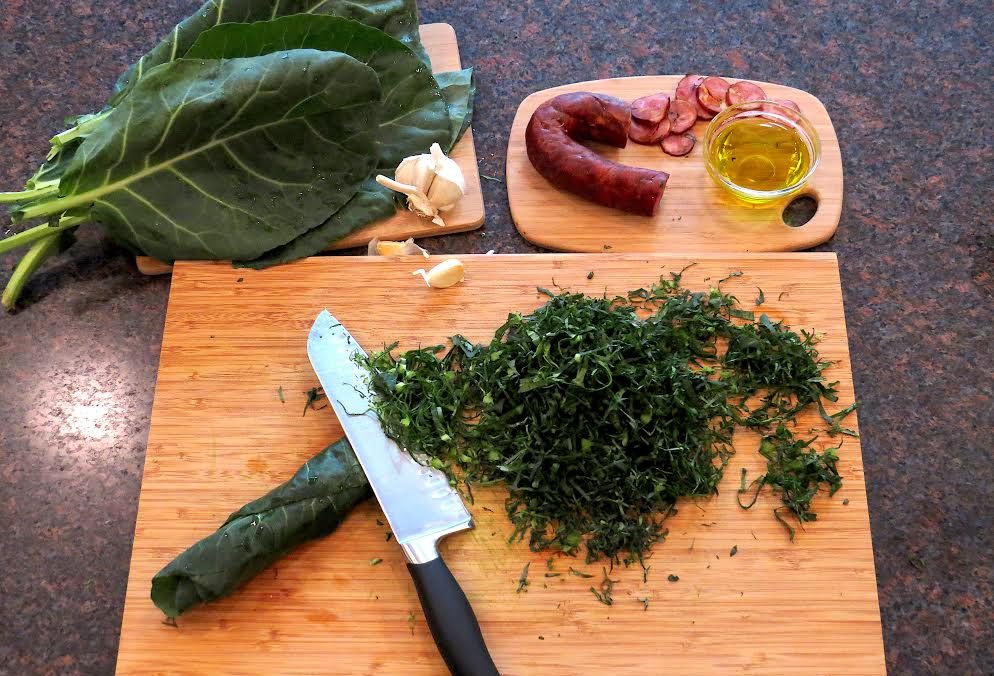
Regarding some of the ingredients: good extra-virgin olive oil is preferable, the traditional liquid is water, the potatoes are floury white (I like to use Yukon Gold for its flavor that resembles the Portuguese yellow potato) and the green is the Galega cabbage/kale with a tall white stalk which originated in Galacia, Spain, but has long been grown in Portugal as well. This tall cabbage is part of the brassicaceae family along with, but not limited to, Brussel sprouts, collard greens and tall kale. Unfortunately, it is not grown in the United States except by immigrants in their backyard gardens. Many immigrants, like my father before me and those of today, plant tons of the homeland galega so they can slice and freeze extra for the winter months and save fall seeds for the next season. Then, when their reserves are gone, the supermarket is where they get collard greens. The collard greens have the flatness of the leaves like the galega cabbage/kale and are close in flavor. Curly kale, a heavier textured green, is mostly used in other soups and doesn’t lend itself well to the traditional cut for Caldo Verde. The stems of the collards or galega are trimmed from the leaves. The leaves are placed in stacks of 3-4 and rolled tightly like a cigar shaped and sliced crosswise into a signature cut of a very fine chiffonade that resembles thin blades of grass. As children, we nick-named Caldo Verde “grass soup.”
As I said, it is a potato-based broth. Before the invention of blenders, we would take the whole cooked potatoes and mash them into a purée on a flat plate or pot cover using a fork and some of the broth, then transfer the mash back to the pot. The texture was not as smooth as we can make it now — all without leaving the pot, thanks to the stick immersion blender.
Finally, chouriço sausage (not to be confused with chorizo, a Spanish or Mexican style sausage) is basically used as a garnish, with extra sometimes served on the side. However, unless I am serving for guests, I toss in all the sausage pieces with the pan drippings before serving. So there you have it and here is the recipe, I hope you enjoy!
Caldo Verde – Portuguese Green Broth Soup
Ingredients
- •1.4 liter (6 cups/about 5 medium) floury white potatoes (such as all-purpose, Yukon Gold, Russet), peeled and cut into medium dice
- •1 small yellow onion, coarsely chopped (about 59 ml/¼ cup)
- •1 garlic clove, whole (optional)
- •15 ml (1 tablespoon) coarse kosher salt or to taste
- •1.2 ml (¼ teaspoon) ground white pepper or to taste (optional)
- •1 bunch (1 to 1 ½ pounds before trimming) fresh collard greens
- •78 ml (1/3 cup) extra-virgin olive oil
- •113 grams (¼ pound) Portuguese chouriço or linguiça sausage, sliced crosswise into .6 cm (¼-inch) coins


Preparation
In a 3.8 liter (4-quart) pot, combine 1.4 liters (6 cups) water with the potatoes, onion, and garlic if using. Cover, place over medium-high heat, and bring to a boil. Reduce the heat to medium and simmer until the potatoes are very tender, about 20 to 30 minutes.
In the meantime, trim the collard leaves off the thick stems. Stack 3 to 4 leaves on to a cutting board and roll up tightly like a cigar. With a sharp chef knife, slice crosswise in very fine shavings called a chiffonade. The slices should be thin like blades of fescue grass. You may need to cut strands in thirds as they sometimes are long like spaghetti. (Practice makes perfect.) Rinse in a large bowl of cool water and drain well. Set aside.
Once the potatoes are well cooked, remove the pot from the stove. Then using a stick immersion blender directly in the pot, puree the contents to a smooth consistency. Return the pot to the stove, bring contents back to a boil. Toss in the salt, pepper and prepared greens. Set side 30 ml (2 tablespoons) of the olive oil and add the remainder to the pot. Stir well and simmer on medium-low for 10 minutes.
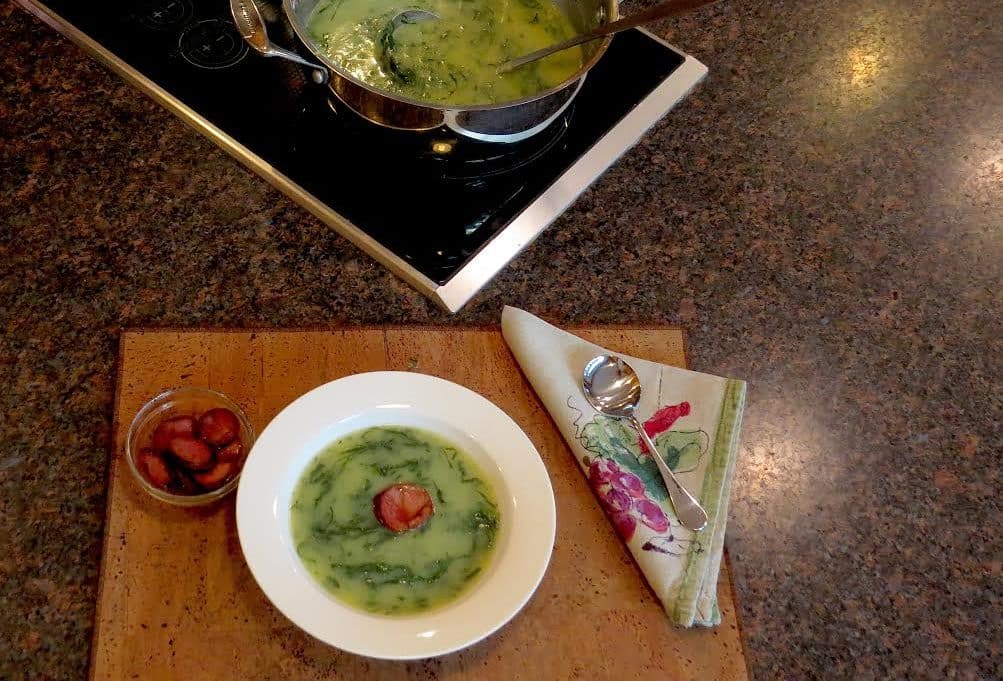
While the collards are simmering, separately in a small skillet, fry the sausage slices in the remaining 30 ml (2 tablespoons) olive oil. Once the broth is ladled into soup plates, it is typically garnished with a slice of the sausage, and the remaining sausage is served on the side.

